
7 September 2026·TURKPOL Editorial
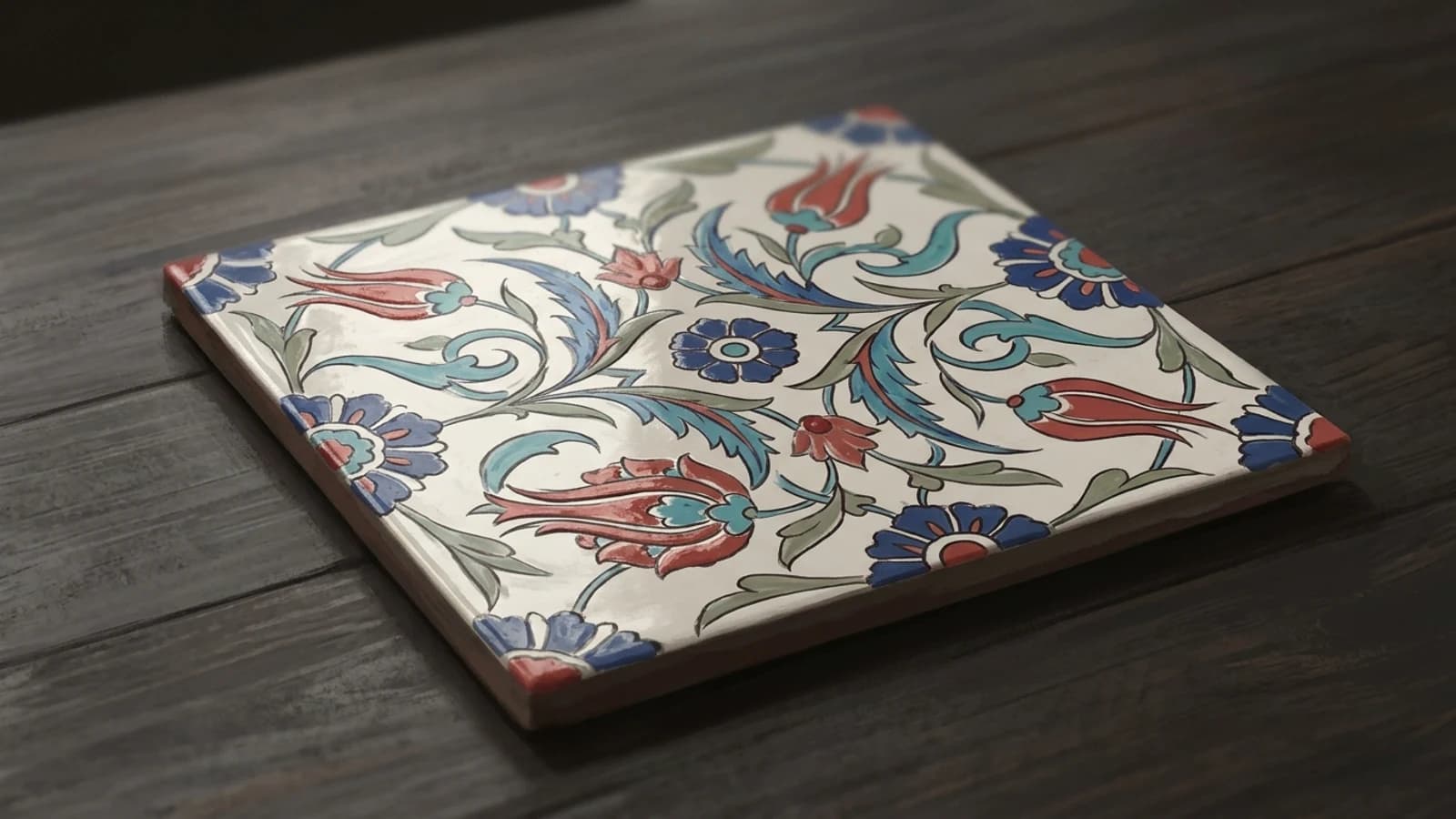
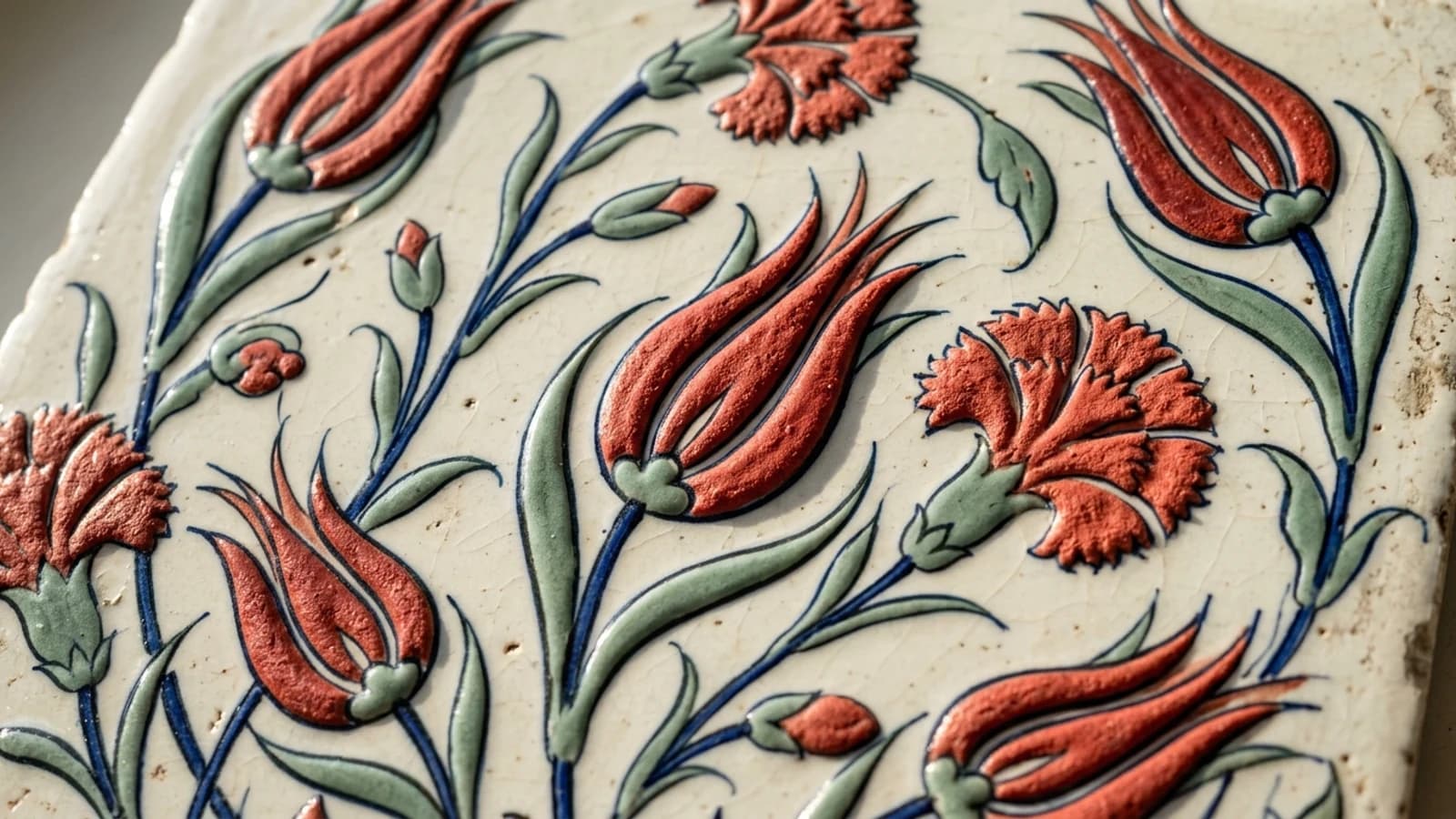
Tilt a sixteenth-century İznik dish under a lamp and the red catches the light first. It stands proud of the surface, a low relief detectable by touch. Cobalt and copper dissolve into molten glaze and become coloured light; iron will not stay in solution as a colourant — dissolved, it goes brown — so the red had to be laid on thick, a clay slip loaded with haematite. The black line round every shape is drawn in chromite, which holds its edge at any temperature the kiln reaches — and does physical work, keeping the dissolved blues and greens from bleeding out of their outlines.
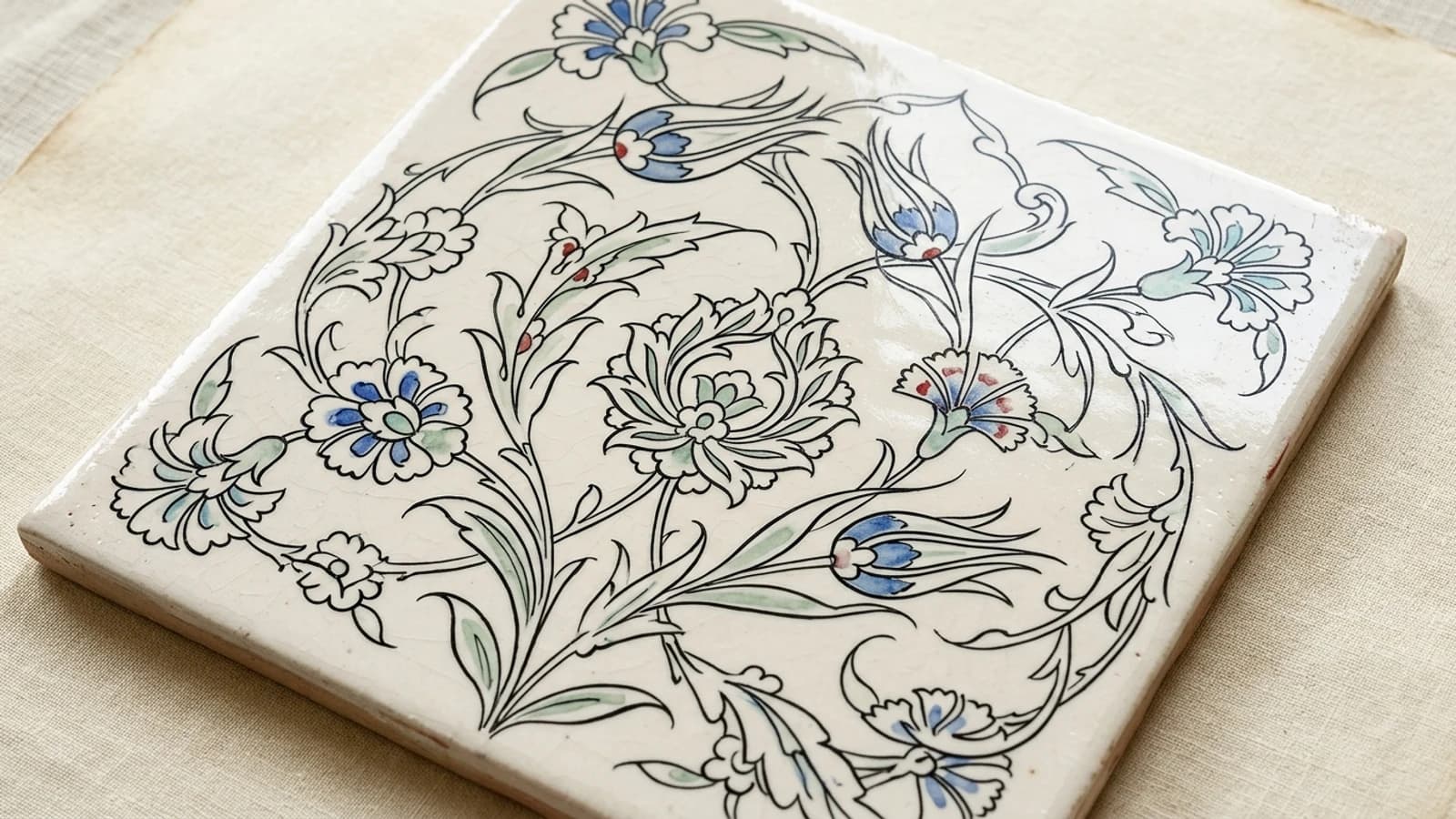
The drawing and the chemistry are one decision. This is a guide to both, and to the road that carried the ornament to Poland — part of the association's long-form series. It was prompted by two Instagram series from the Kütahya çini artist Süleyman Turan, on fifteen important motifs and on the colours of Ottoman-Turkish çini; he works in the town this article ends in. Çini is a loan from Persian çīnī, "Chinese work": the art is named for the country whose wares it set out to rival, and what it made of them was adaptation, not imitation.
Two families: rumi and hatayi
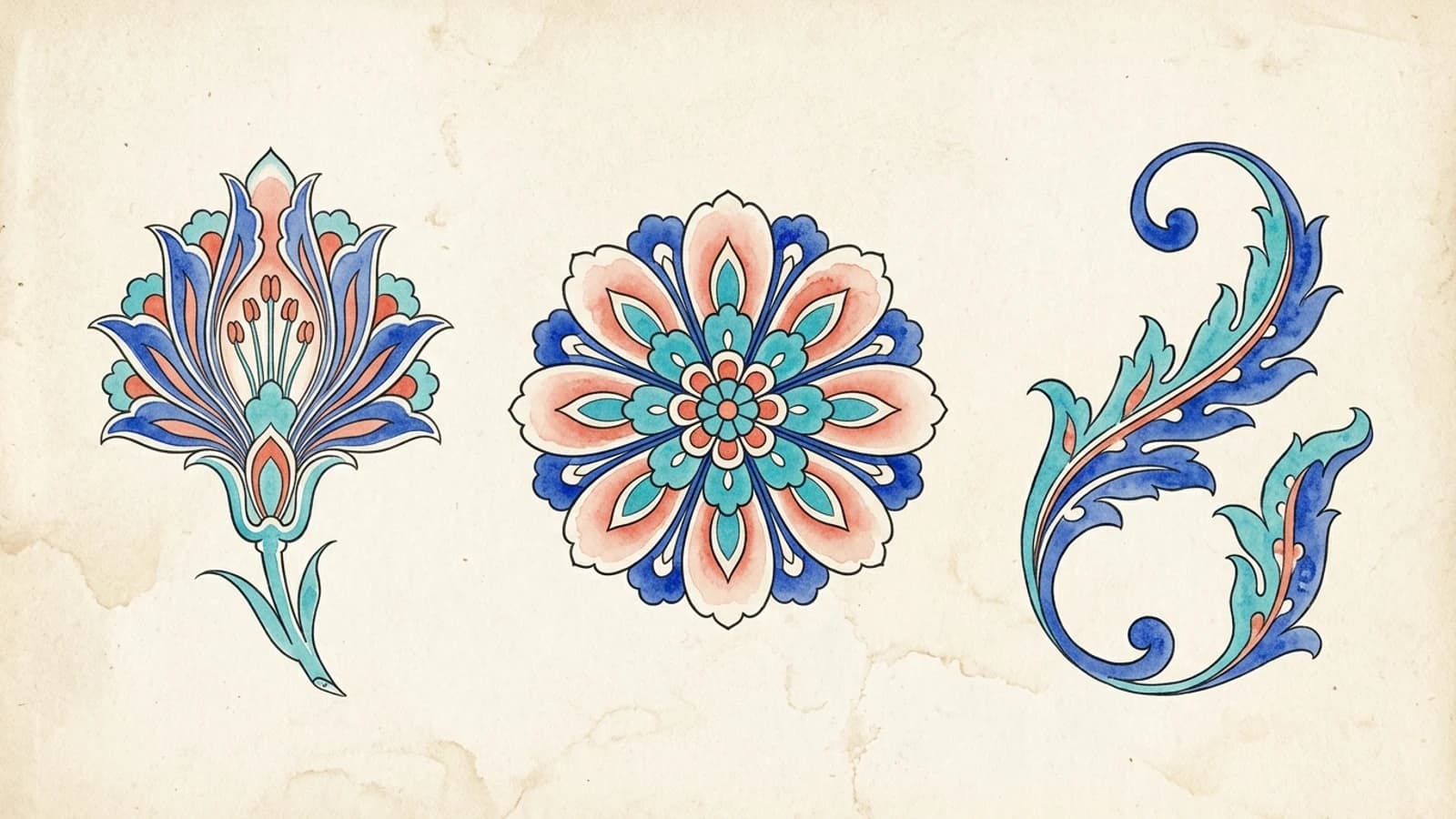
The rumi is the curling, forked, quasi-vegetal element that carries a design across a surface. Its name comes from Rûm: Anatolia was Diyâr-ı Rûm, the land of the Romans, meaning the Byzantines. The name is not a claim about where the style began — it runs from al-Andalus to Central Asia, and its origin is argued over, an animal ancestry and a plant one both proposed, neither settled. Within the craft its parts are named for the job they do: ayırma, tepelik, ortabağ.
The hatayi is not a flower but the stylised longitudinal section of one, the plant cut vertically and redrawn along its anatomy. Its companion, the penç, is the same imagined plant seen from above: side elevation and plan, in an architect's terms. The penç is the workhorse — its stem joins underneath and is invisible, so it has no direction and can send a stem out on any side, reason enough without symbolism to turn up wherever stems cross. Hatayi means "from Cathay"; the transmission usually given runs Central Asia to Iran to Anatolia.
One motif carries an argument rather than a route: the çintemani, three discs alternating with two wavy bands, read as a wish-granting jewel, a leopard's pelt standing for sovereignty, or tiger stripes that avert evil. Anyone offering a single meaning has chosen it. Syrian potters copied the design too: a çintemani tile in the Victoria and Albert Museum was made in Damascus, not İznik — so not everything that looks İznik is İznik.
When the garden came indoors
Two artists changed the repertoire. Şahkulu trained at Tabriz and, after Selim I's victory at Çaldıran in 1514, was among the artists relocated to Istanbul; by 1545 he headed the Anatolian section of the palace design workshop. He was the leading figure in the manner called saz — long serrated leaves with curling tips, dragons and peris among them — whose earliest appearances on tile, the Circumcision Room panels at the Topkapı, are dated to around 1530 on style rather than by document.
His pupil Kara Memi, chief painter to Süleyman, brought garden flowers into design, drawn with their own stems and called by their own names rather than absorbed into the hatayi system: tulip, rose, carnation, hyacinth, cypress.
The tulip did not arrive with him. Flowers read as tulips appear on thirteenth-century Anatolian Seljuk palace tiles, though that reading is an interpretation, not a certainty; the same forms are read as lotus or palmette. In Arabic script lâle and Allâh use the same letters and both total sixty-six, a conceit belonging to Ottoman Sufi and Bektashi literature. But no workshop document says a tile painter meant it, and Gülru Necipoğlu's study of the Topkapı scroll turns on how little of that world's design thinking was ever written down. The conceit is a reader's, not a painter's.
The colours, in order
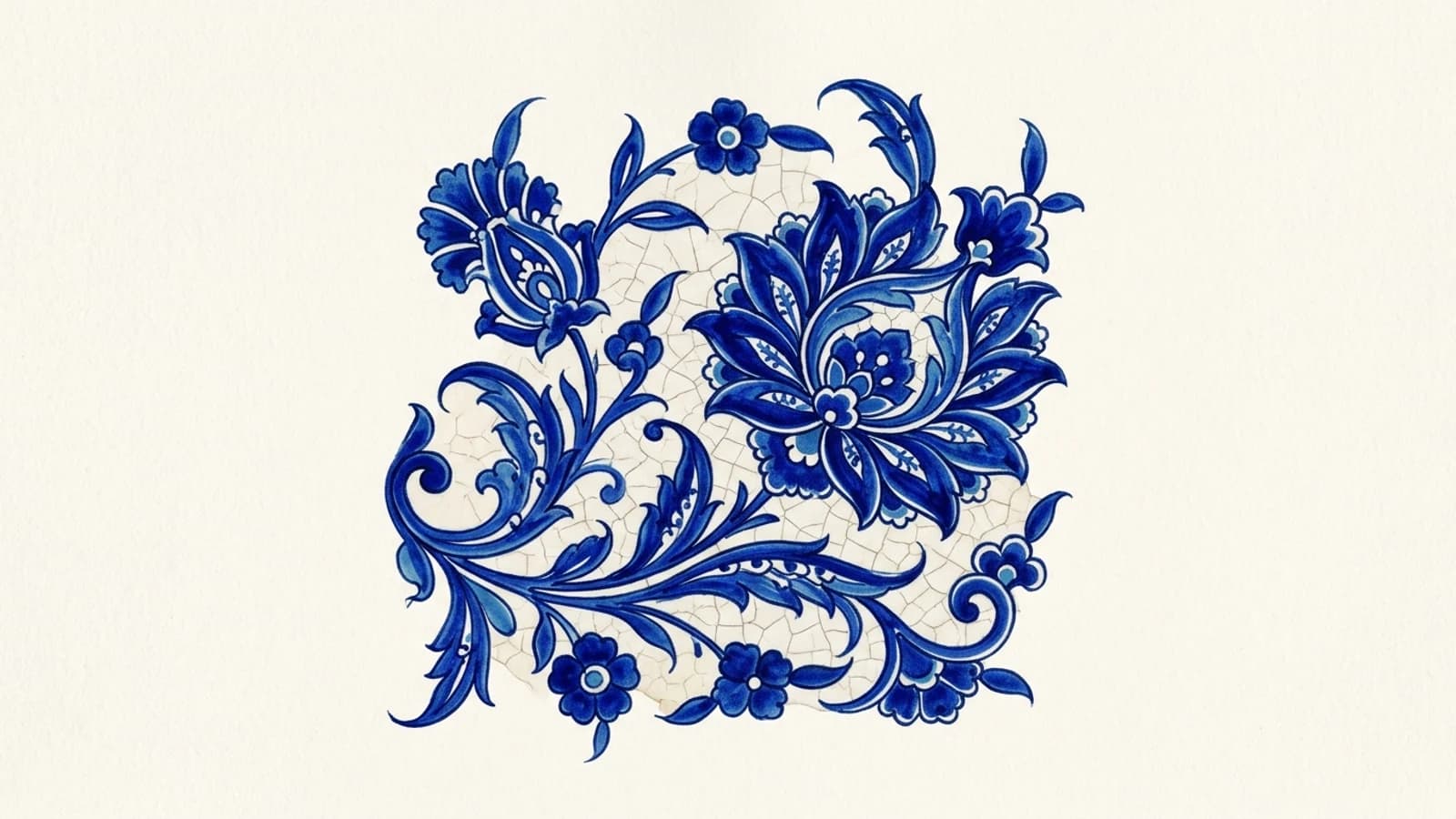
The chronology here follows Atasoy and Raby. From the 1480s to 1520 there is one colour, cobalt blue on white, the cobalt probably mined at Qamsar near Kashan.
By the 1520s turquoise appears, from copper.
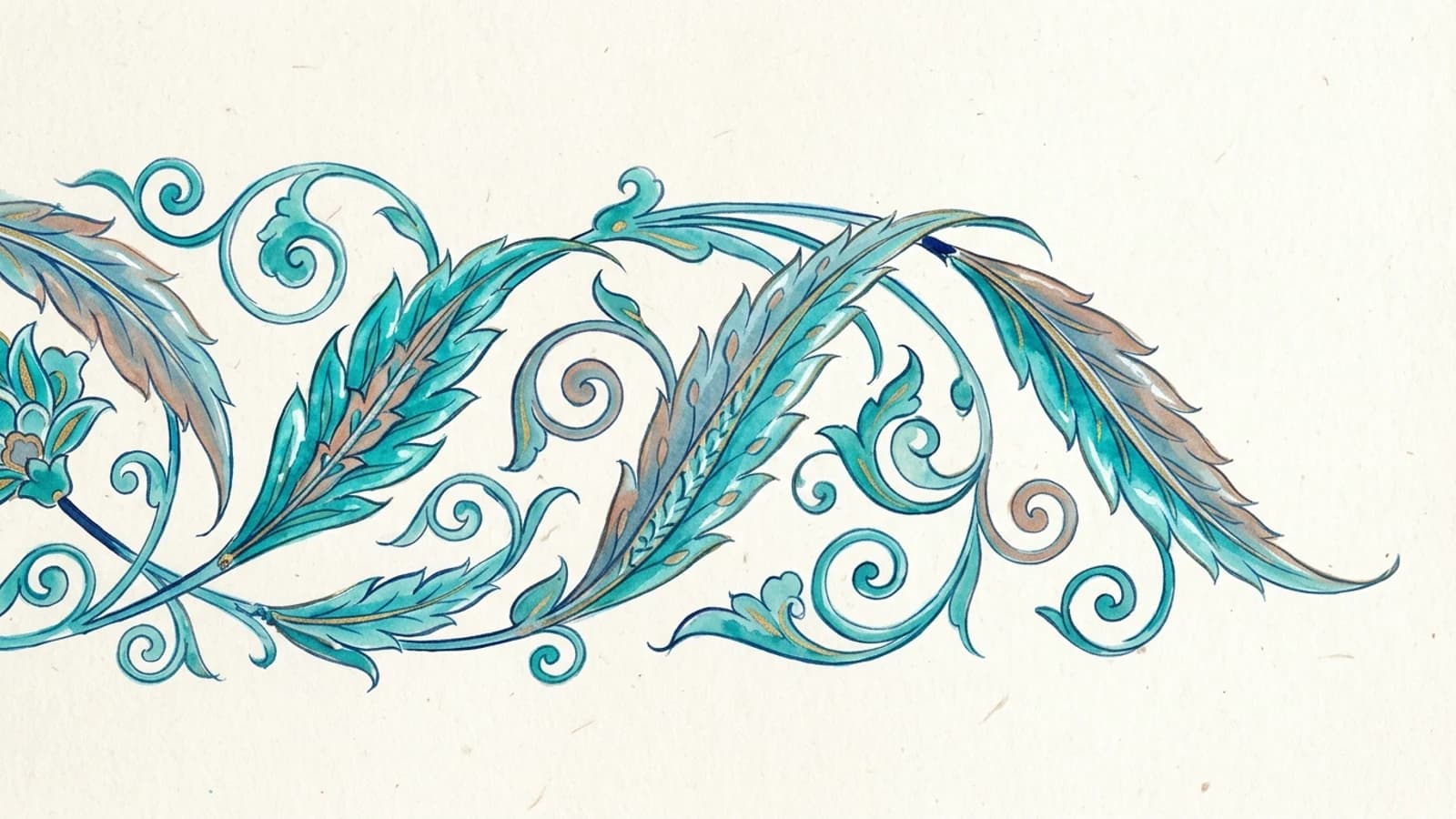
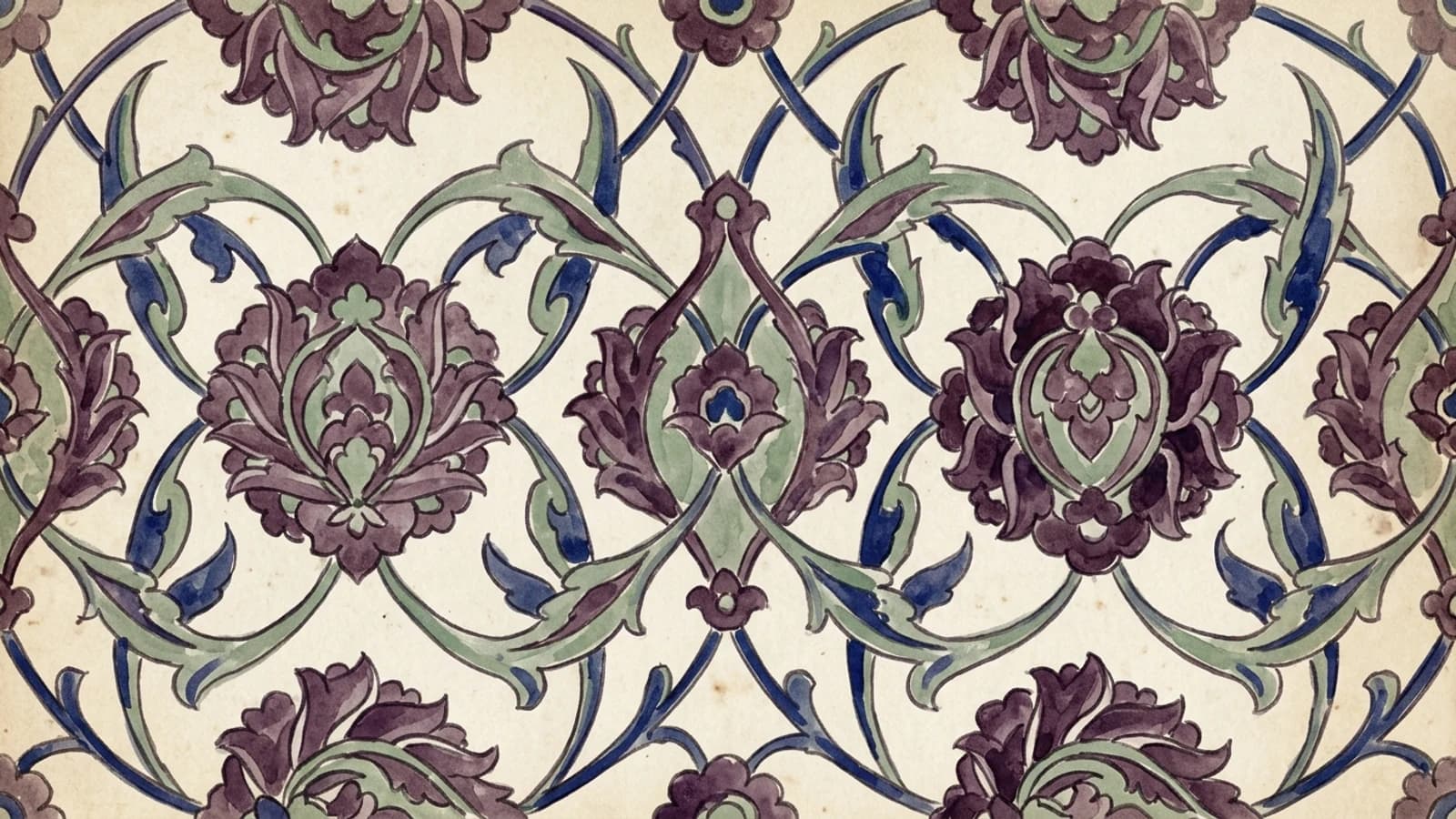
Around mid-century a sage green and a manganese purple join it.
The two colours that displace them do not arrive together. The coral red comes first, thin and brownish, on the courtyard lunettes of the Süleymaniye, finished in 1557.
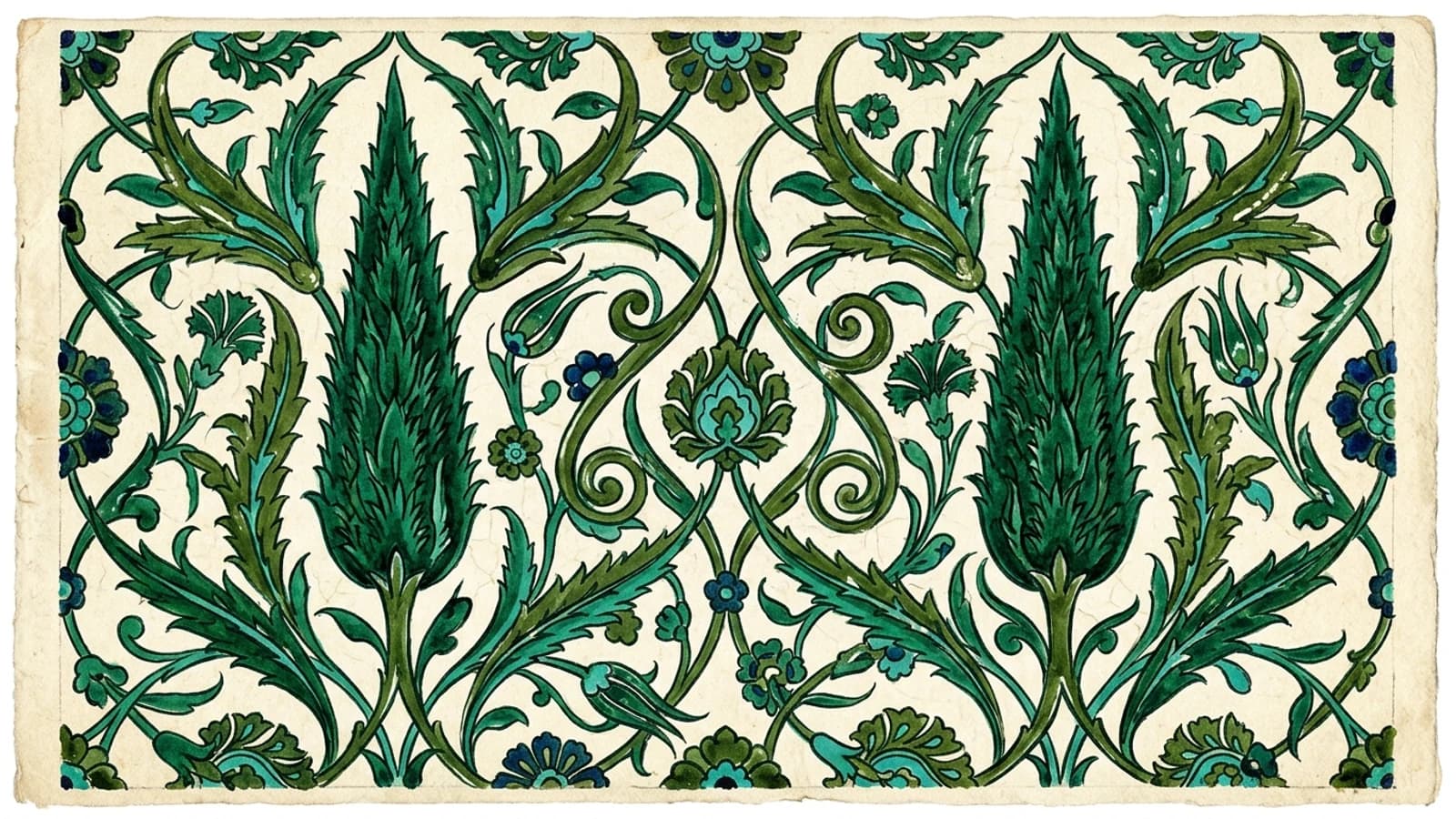
The emerald green follows about a decade later, on the portico panels of Süleyman's tomb of 1566–67.
The body was biscuit-fired first; then everything — outline, colour, glaze — went through a single glaze firing together. There was no second, cooler enamel firing as in European overglaze work, so every colour had to survive the same fire at the same moment. That is why the palette is small. No workshop or treatise source documents a fixed Ottoman code of colour meanings.
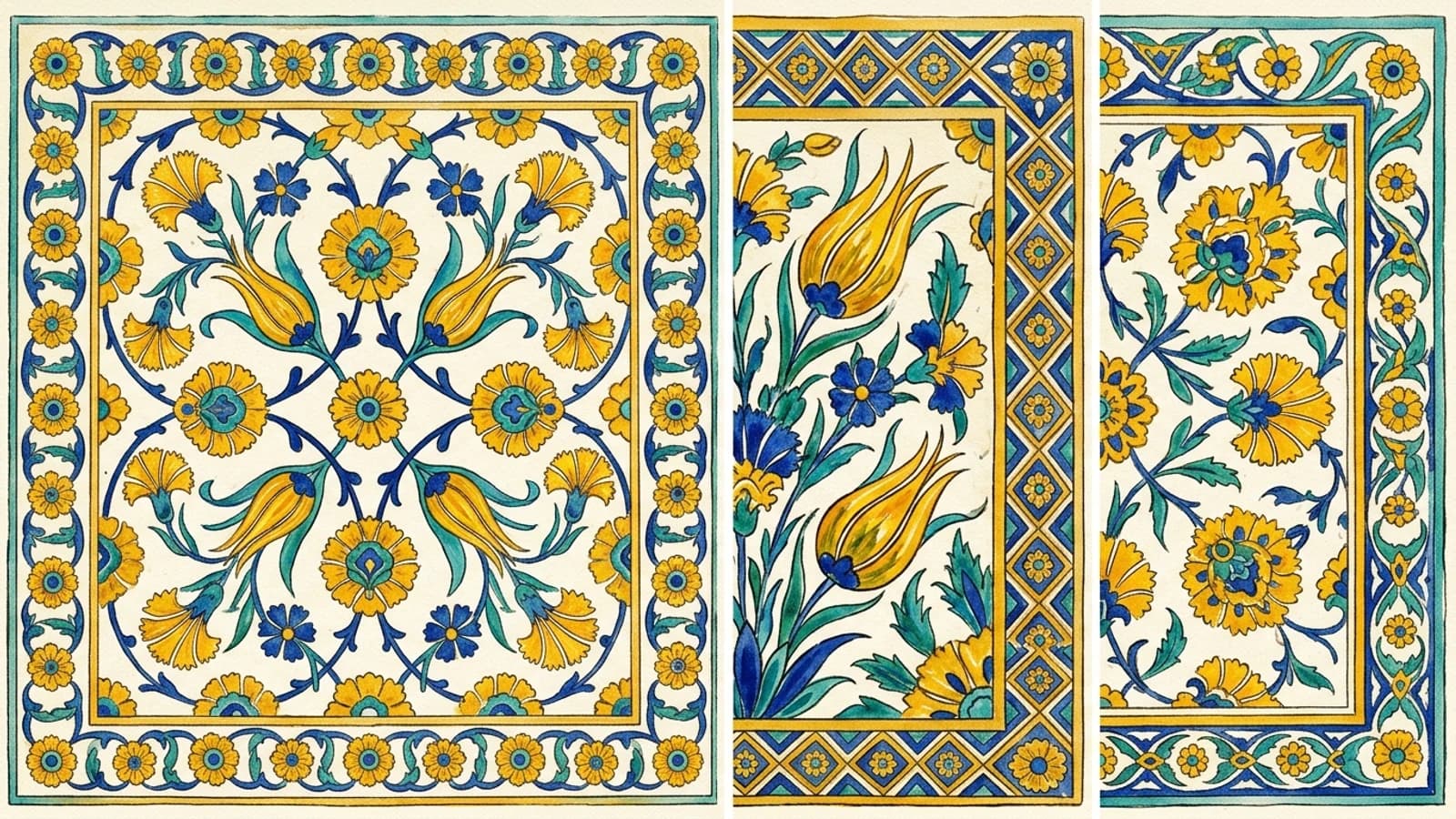
The red was also the first to go. The romance says the secret was lost; the chemistry says otherwise. Haematite ground too fine, or fired too hot, dissolves into the glaze and turns brown. What was lost was not a formula but tacit skill. One colour, meanwhile, is missing from the classical İznik palette entirely: yellow, and brick red with it, belongs to Kütahya.
İznik, and then Kütahya
The classical palette was court-run: imperial decrees went to the judge of İznik, ordering the sultan's commissions first. At the Sultan Ahmed Mosque, 1609 to 1617, the price per tile was fixed by decree while prices rose, and quality fell across the job. Court patronage then went — alongside those fixed prices in a severe inflation, a slump in imperial building, and cheap Chinese porcelain arriving through Dutch trade. The industry did not survive the combination. Evliya Çelebi, passing through in 1648, found a handful of workshops still working; the last dated İznik pieces are of the 1670s.
Kütahya did not take over: it had produced in parallel with İznik, and it outlived it. But because the town has never been excavated on the scale of İznik's kiln digs, Ottoman wares of these centuries are attributed to İznik by default — and the earliest dated piece in the style is caught in it: a ewer conventionally given to İznik, carrying an Armenian commemorative inscription of 1510 and known ever since after Abraham, a man of Kütahya.
From the early eighteenth century Kütahya found an idiom of its own, for ordinary life: coffee cups above all, and street life rather than the court. Armenian, Greek and Turkish potters all worked in these towns. David Ohannessian was master of a Kütahya workshop from 1907 to 1915; in 1919 Ronald Storrs, military governor of Jerusalem, engaged him to retile the Dome of the Rock, and that autumn he returned to Kütahya for clays and glazes and recruited surviving Armenian ceramicists to join him. That biography was assembled by Sato Moughalian in Feast of Ashes (Stanford University Press, 2019). The Armenian ceramic tradition of Jerusalem begins there.
Late in the nineteenth century, as İznik ware rose in value on world markets, Kütahya's masters were pushed back into the classical İznik repertoire. A Kütahya workshop today painting rumi, hatayi and the classical colours is not simply continuing a local inheritance; it is working in a revived İznik style its own town adopted, set aside and adopted again.
The Polish thread
Here is the plain shape of it: the ornament reached Poland and the tile did not. What crossed were portable things — tents, carpets, sashes, sabres, silver — so the motifs travelled on textile and on metal. Tile is architecture: it goes up on a wall in Bursa or Istanbul and stays there.
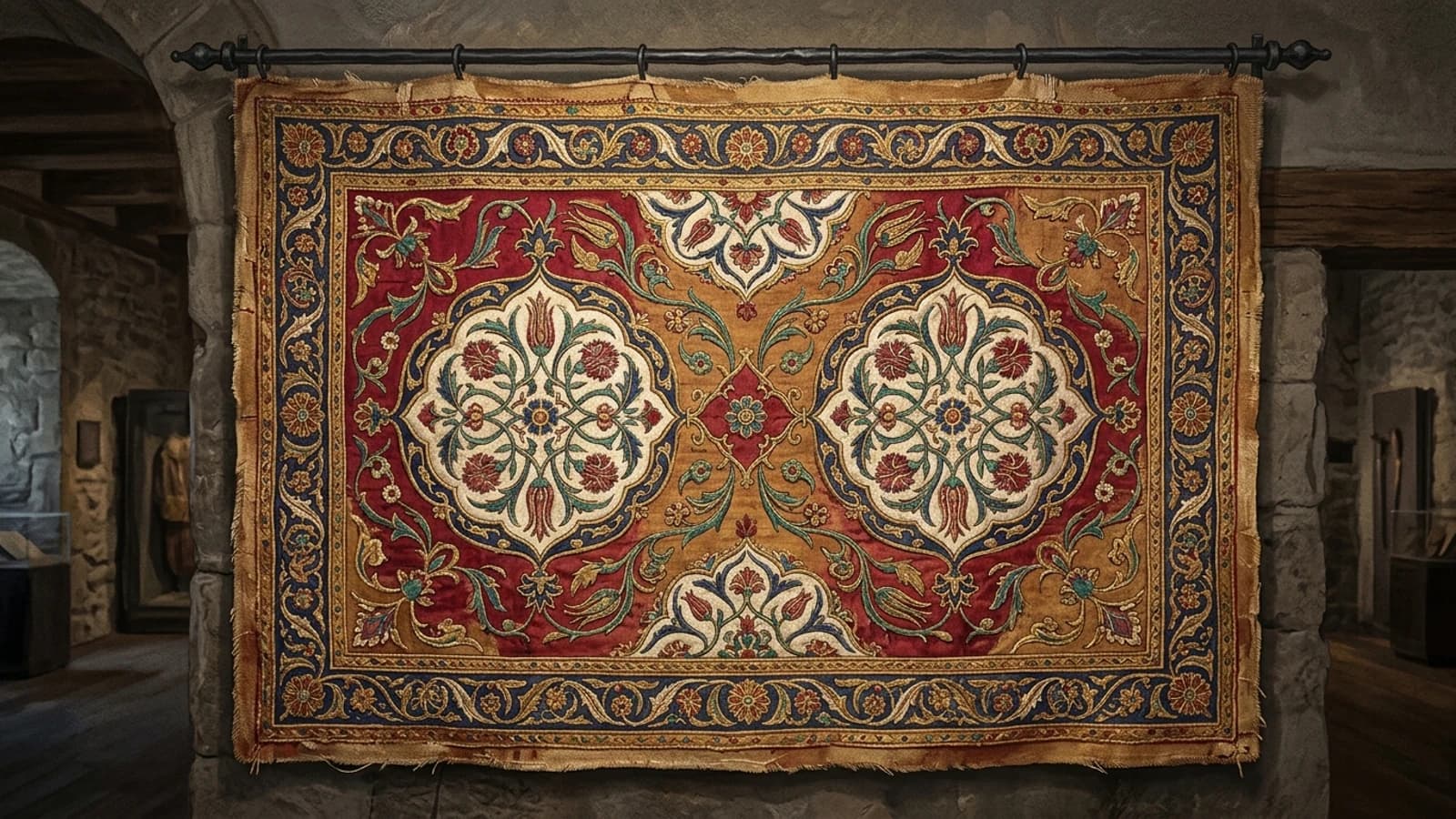
The thread is therefore one of ornament, not of ceramics, and Wawel Royal Castle — holder of the largest collection of Ottoman tents in Europe, by its own account — is where to see it. The tents' decoration is medallions of intertwining flowers, described as stylised carnations and tulips: two motifs straight out of the çini repertoire, in Kraków, on canvas.
Provenance here is unreliable in one direction. A story of capture at Vienna in 1683 has always been easier to attach to an Eastern object in Polish hands than a purchase record is to find; much of what is in Polish collections was bought, commissioned or received as a gift, and the war story covers the merchant's paperwork. Sarmatism, the culture of the Polish–Lithuanian nobility, took such things in through war and trade faster than it understood them.
The best cautionary tale runs the other way. The silk and metal-thread carpets called tapis polonais were named at the Paris exhibition of 1878, where carpets from Prince Władysław Czartoryski's collection hung in a Polish room under his coat of arms — arms read as Polish, the carpets thereby taken for Polish work. Alois Riegl in 1891 and Wilhelm Bode in 1902 dismantled the attribution; Tadeusz Mańkowski later identified the man the Słuck theory was meant to name, Jan Madżarski, who wove sashes rather than carpets and was at Słuck from 1758, a century and a half after the carpets, which are Safavid Persian. The attribution was made in Paris on Polish testimony and undone in Vienna and Berlin. A Polish connection did exist — Sigismund III Vasa sent the Armenian merchant Sefer Muratowicz to Kashan in 1601 for carpets with the royal arms — but it was commissioning, not weaving, and 1878 mistook the second for the first.
Even the tulip runs the wrong way for romance. By 1683 the flower had already made the long way round — through Vienna, Augsburg, Bologna and Leiden — and Poland has no documented part in that journey west.
The tile itself arrives later, and as a collected object rather than a captured one. Wawel's ceramics collection records that in the 1960s a large and precious collection of Chinese, Japanese, Turkish and Persian ceramics was purchased from Pelagia Potocka. Whether any of it is İznik is a question for the castle rather than for us. We would print the answer.
Where to look
In Poland, Wawel, for the tents: the ornament that did not reach the country on a tile reached it on canvas.
In Türkiye, Bursa comes first: the Green Complex, its mosque finished in 1419–20 and its tilework in 1424, carries a mihrab inscription crediting the work to masters of Tabriz — Ottoman tile has an Iranian and Timurid parentage before it has an İznik one. Then Istanbul, for the contrast between the Süleymaniye, where Sinan held the tile to the mihrab wall, and the Rüstem Pasha Mosque, finished in the early 1560s, where tile covers almost every surface; Ottoman and Seljuk ceramics are shown as a collection at the Çinili Köşk, the Tiled Kiosk of the Istanbul Archaeological Museums. Kütahya is the one stop on this list where çini is a living trade and not only a conserved one: the tile museum, and the workshops on Germiyan Sokağı. Opening arrangements and what is on display both change; confirm İznik, the Tiled Kiosk, Kütahya and Wawel's current display before travelling.
Süleyman Turan, in Kütahya
A list of fifteen motifs, of the kind Süleyman Turan set out, is how the vocabulary is handed on in a Kütahya workshop — master to apprentice — and it is why a rumi drawn there this year is the same element as one drawn in 1560. His work is at instagram.com/suleymanturan.art, and that is where a reader who has got this far should go next.
If this is the sort of history you would like the association to keep writing, the timeline of Polish and Turkish ties gathers these threads, membership makes the work possible, and corrections are welcome through our contact page.