18 May 2026·TURKPOL Editorial
Languages keep receipts. When two peoples trade, fight, travel and settle near each other, the words move with the goods, and they stay long after the trade route closes.
The traffic was mostly one way
This needs saying plainly, because the temptation with a friendship series is to make everything symmetrical. It was not. Polish absorbed a substantial layer of Turkic and Ottoman-Turkish vocabulary. Turkish absorbed very little Polish.
The reason is structural. From roughly the fifteenth to the eighteenth century, the Ottoman Empire was the dominant commercial and military power on Poland's southern horizon, and the Polish–Lithuanian Commonwealth's south-eastern frontier was in constant contact with Turkic-speaking peoples — Crimean Tatars above all, who had lived in Poland–Lithuania since the fourteenth century.
Some of what came across
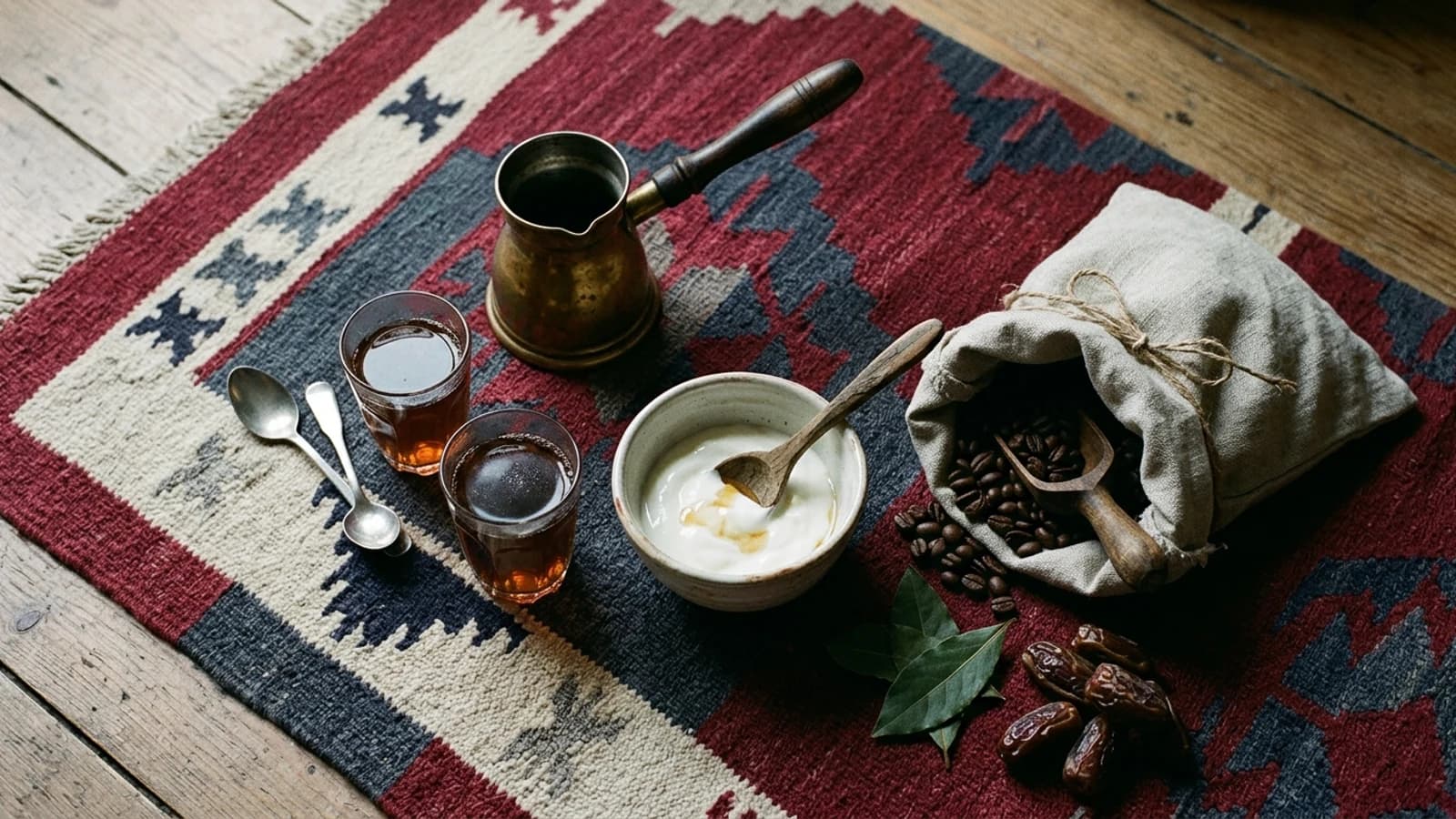
- kawa — coffee, from *kahve*. The drink and the word arrived together, in the seventeenth century, along the same route.
- jogurt — from *yoğurt*, a genuinely Turkic word that reached most European languages.
- dywan — carpet. In Turkish and Persian *divan* meant a council, then the room it met in, then the low seating in that room. Polish took the furnishing.
- chałwa — halva, from *helva*.
- torba — bag. Still completely ordinary Polish.
- kilim — the flat-woven rug, borrowed with the object.
- ułan — the light cavalryman, from Turkic *oğlan*, "young man". The word left Polish for French, German and English, so a British lancer regiment carries a Turkic word through Polish.
A caution: etymology is rarely a straight line. Many of these reached Polish via Persian, Arabic, Tatar or Ruthenian rather than directly from Ottoman Turkish, and specialists disagree about individual cases.
The word that went the other way
Turkish for Poland is Lehistan. Turkish for a Pole is Leh. Both come from *Lech* — the legendary founder of the Polish nation.
That single borrowing outweighs the rest of the traffic in significance, because it is the name in which every Ottoman document about Poland was written — including, in the story every Pole knows, the announcement that the envoy from Lehistan had not yet arrived.
The other Polish contribution to the Turkish map is Polonezköy — "Polish village" — the settlement founded in 1842. A place name is a heavier loan than a noun: you cannot stop using it without renaming somewhere.
Vocabulary records what two peoples exchanged. Place names record where they stayed.
Why this matters for learners
For a Turkish speaker starting Polish, the shared vocabulary is a small gift and a small trap. *Kawa*, *torba*, *jogurt*, *kilim* and *chałwa* arrive free. But Polish grammar — seven cases, verb aspect, consonant clusters — shares nothing with Turkish, which is agglutinative with vowel harmony and no grammatical gender. The familiar words are the last easy thing you will meet.
Polish courses and language exchanges run through our clubs, and the practical arrival steps are in the guides.